
Fall River Past Residents Sources
No single source identifies everyone who lived at a Fall River address. Recorded land shows ownership transfers and legal descriptions. City directories supply an address and household or business lead. Census schedules are household snapshots, while obituaries and probate can explain why a name disappears. The best starting record depends on the time period, but the current assessor parcel and a recent deed create the strongest bridge to earlier material.
| Source | Years it covers | Where held | What it shows |
|---|---|---|---|
| Registry land records | Office since 1883; Book 1 to present images; observed name range 1947 to present | Fall River Registry and land portal | Transfers, legal descriptions, plans, and encumbrances |
| City directories | Documented 1853 to 1997; digitized 1853 to 2021 | Library, Community History Archive, and FRHS | Address, occupant or business lead, and historical directory clues |
| Federal census | Local microfilm for 1850, 1880, 1900, 1920, and 1930; later records follow release rules | Library and released census sources | Household composition and a snapshot-year address |
| Local and state vital records | Local microfiche 1803 to 1889; state digital records 1841 to 1935 | Library, City Clerk, RVRS, and Archives | Birth, marriage, death, and relationship leads |
| FRHS valuation books | 1827 to 1840 and 1841 to 1860 | Fall River Historical Society | Names, polls, property descriptions, values, and tax |
| Sanborn maps | 1888, 1893, and 1905 | Library of Congress and local collections | Building footprint, use, and street context |
Start near the present when a parcel is known. Start with a directory or valuation-book reference when the search is already historical. The different records should remain separate until dates, legal description, and address evidence connect them. That is how a prior-owner trail becomes a credible past-residents trail.
Fall River Past Residents Deed Chain
The Fall River Assessor is the address-first start. Search by street and number, owner name, or parcel ID and save the present owner, situs address, mailing address, parcel ID, assessment year, legal description, and any plan or book-and-page reference. Situs is the physical parcel address. A mailing address is where tax correspondence is sent and can be different. The assessor warns that ownership data can lag a recent transaction, so a recorded deed is the stronger evidence of transfer.
Use the Fall River recorded-land portal to search the current owner as grantee around the likely purchase date. Open the purchase instrument, capture the grantor, prior deed reference, book, page or document number, and legal description. Then search that grantor as an earlier grantee. If a deed names a trust, estate, corporation, or several people, test the exact entity and each relevant name form before deciding that the chain has stopped.
- Save the current assessor parcel and distinguish its situs from the mailing address.
- Locate the current grantee’s purchase deed and copy the grantor, recording reference, and legal description.
- Search that grantor as a prior grantee, using the earlier purchase date and Fall River location.
- Repeat one instrument at a time, retaining plan and book-and-page references with each link.
- When the online name range ends, use the Registry, library, archives, or other documented historical assistance rather than treating a blank web result as a missing deed.
- Grantor and grantee
- The grantor transfers an interest. The grantee receives it. In a backward search, yesterday’s grantee can become the next earlier grantor.
- Chain of title
- The documented sequence of transfers for a parcel or interest, read one instrument at a time.
- Legal description
- The land description, lot reference, plan, or metes-and-bounds wording that can remain useful when a street number changes.
Fall River Past Residents Name Gap
The Registry has held Bristol district land records since 1883, and its image availability reaches Book 1 to present. Its observed online certified name range begins in 1947. That difference matters for a past-resident search: a missing online name result before the cutoff is not evidence that no deed exists. A later instrument’s book, page, legal description, or plan reference can point toward the older record even when the name interface does not.
For earlier work, contact the Registry or use its office records, then consult local historical indexes, Massachusetts Archives finding aids, accessible FamilySearch deeds and wills material, and library or FRHS research support. The Registry’s image-availability notice explains the book sequence that can be older than the searchable name interface.
Review the Registry image-availability notice before deciding where the online search ends.
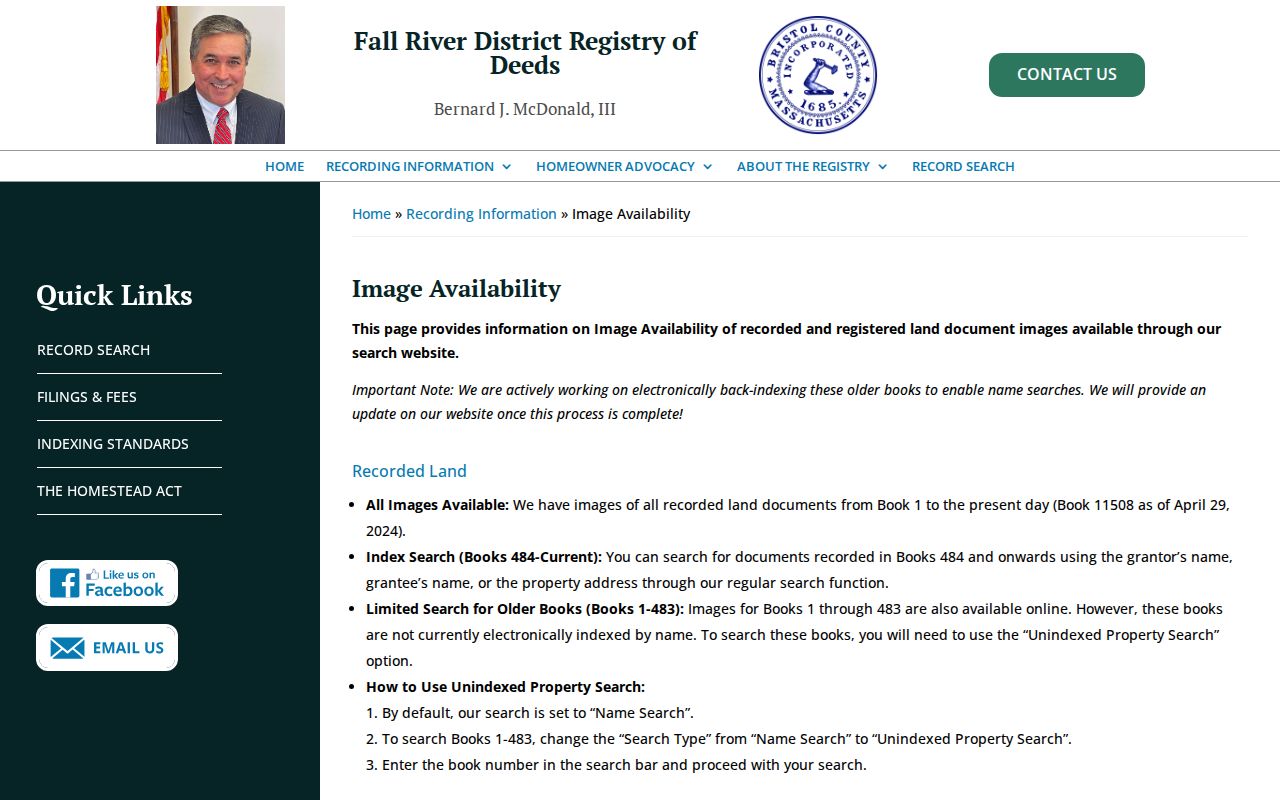
The image coverage and name-index range are different access facts, so preserve both in the address research notes.
Note: The Registry’s current search range can change, while the historical book and image sequence is a separate question for office confirmation.
Fall River Past Residents Directories
Deeds identify transfer parties, not every person at an address. Fall River city directories fill many years between transfers. The Fall River Public Library holds directories on microfilm from 1853 through 1967, with later print runs, and the digitized Community History Archive lists the city-directory collection from 1853 through 2021. The Fall River Room is a non-circulating local-history collection. Search OCR when useful, but browse the year and page when a surname fails because OCR can misread names.
Directories were not always annual at the beginning. The local trail begins in 1853, and annual publication became more reliable around 1869. An entry can give an address, occupation, business, and household context, but it is normally a head-of-household or business lead, not a full resident list and not deed ownership proof. The collection details and how to read a particular edition are concentrated on the Fall River city directory page.
Use the Fall River Public Library genealogy resources for the local mix of directories, newspaper microfilm, census, and obituary-request help.
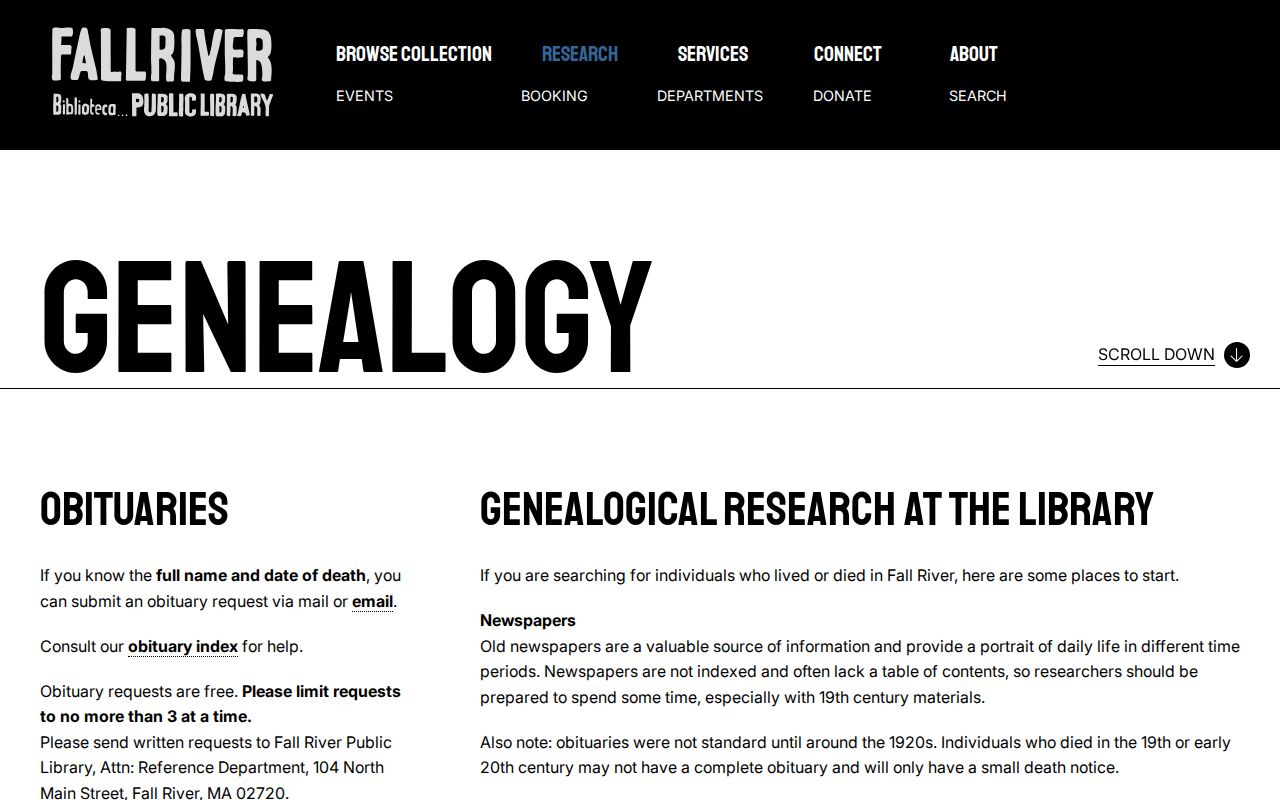
Those resources support a household trail around a deed date without converting a directory line into a claim about every occupant.
Fall River Past Residents Census
A directory year and nearby census year test different parts of the same historical question. The library’s local microfilm includes 1850, 1880, 1900, 1920, and 1930 federal census records. A census can supply household composition, ages, birthplace, and occupation at a snapshot in time. A directory can place a head of household or business at a street address close to that date. Neither record should be read as a permanent description of the household.
- Choose the first directory edition after a recorded transfer and transcribe the address and name exactly.
- Check a nearby released census year for a household that matches the person, address area, or family clues.
- Compare a second directory edition before or after the census to identify a move, new business, or changed address wording.
- Use an obituary, vital index, probate file, or recorded deed to test the transition when a name disappears.
Federal census images follow a 72-year release rule, and the library’s listed local microfilm years are not a continuous run. Pairing sources by date makes those gaps visible instead of filling them with assumptions.
Fall River Past Residents Map Check
Sanborn maps date the physical setting, not the people who lived there. Fall River examples from 1888, 1893, and 1905 show building footprints, materials, uses, streets, and block context. The 1893 map has 76 sheets. Use a sheet to test whether a building existed, whether a lot or street layout changed, or whether a directory address needs a different map reference. Do not use it as a household roster.
Maps work best with the legal description, plan, or nearby named parcels from the deed chain. When a later street number looks unfamiliar, compare the map, directory year, and deed description before treating it as a different property. The assessor’s modern parcel ID and MUGIS are current geographic aids; older land continuity often rests on the plan and legal-description language.
Fall River Past Residents Address Shift
Old addresses are not fixed identifiers in Fall River. A Historical Society newsletter documents a 1875 renumbering in which 66 Second Street became 92 Second Street. A search that uses only the modern number can therefore miss a directory entry, deed reference, newspaper item, or map sheet for the same place. Record both forms, search the street with nearby names, and compare the legal description or plan rather than relying on the address string alone.
Place names can shift as well. FRHS records that Fall River was called Troy from June 1, 1804 to February 12, 1834. Early material may use Troy even where the physical place is now Fall River. This is a research quirk with a practical effect: a correct historical search may need both city names and both street numbers in its notes.
Fall River Past Residents Estates
An obituary can connect a former address to relatives, a spouse, a funeral notice, or a date that directs the next record search. Probate can identify an estate, executor, heir, or property-related filing. These sources help explain why a former owner or directory name disappears, but neither replaces a deed when ownership is the question. Recent probate material may also be restricted, so ask the Probate and Family Court about the public file rather than assuming it is online.
The library obituary index is a pointer to the newspaper, not the complete notice. It offers up to three free requests by full name and date, and printing is 25 cents per page. Local newspapers also have title and language gaps, including French and Portuguese runs. Search the date and title that fit the person’s period, then retain the publication as a cited source rather than folding the information into an unsupported household claim.
Fall River Past Residents Collections
The Fall River Historical Society holds valuation books, directories, municipal documents, newspapers, maps, manuscripts, and other local material. Its valuation books include unbound 1827 to 1840 volumes and bound 1841 to 1860 volumes with names, polls, property descriptions, values, and tax. The Society has also reported 2025 cataloguing and reshelving work involving directories, city documents, poll-tax records, school reports, water-works records, and probate groups. Confirm current appointment availability before a visit because collection access and closure notices can change.
For an online supplementary lead, the FamilySearch Massachusetts wills and deeds collection may help where access is available, but its exact Fall River image coverage should be checked. The Historical Society and library remain the stronger local route for a question that needs original city materials, a map, a directory page, or a local newspaper reel.
The collection is a finding aid alongside the Registry and local holdings, not a substitute for confirming a particular Fall River deed image.
Lawful Fall River Past Residents
House history, family history, estate research, and personal curiosity can support a careful search for who lived here before. Public status does not authorize tracking a living person, exposing protected details, repeated unwanted contact, harassment, threats, impersonation, or attempts to work around confidential-voter, ACP, sealed, or impounded records. Massachusetts criminal harassment law is M.G.L. c.265 §43A, and a records request does not override a statutory restriction.
Lawful use. Use Fall River past-resident research for documented house and family history. Do not use old address records to stalk, harass, intimidate, expose, or harm any person.